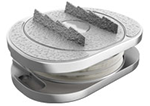
Beyond Spinal Fusion Surgery: The Patient’s Guide to Motion-Preserving Disc Replacement Surgery
A comprehensive clinical and biomechanical guide for patients evaluating spinal fusion, discectomy, and artificial disc replacement (ADR / TDR).
This guide provides prospective spine surgery patients with the critical biomechanical, clinical, and anatomical knowledge required to evaluate modern motion-preserving surgical options versus traditional fusion procedures.
Fusion Surgery or Disc Replacement – The Fork in the Road
Few moments in a person’s life carry the weight of sitting in an orthopedic or neurosurgeon’s office, reviewing a backlit MRI of a collapsed or herniated disc, and hearing the recommendation: “You need surgery, and fusion is your standard option.”
When you are living with debilitating back or neck pain, where basic daily tasks like shoulder checks while driving or bending over to tie a shoe trigger radiating radicular nerve symptoms, the promise of relief feels urgent. However, accepting a surgical intervention without understanding the fundamental mechanical difference between immobilization (fusion) and motion preservation (arthroplasty) is a critical oversight.
For decades, spinal fusion has served as the default surgical answer to degenerative disc disease. Surgeons approached the spine like a broken structural beam: when a shock absorber fails, remove it, pack the interbody void with bone graft or a rigid spacer, and weld the adjacent vertebrae into a single, immobile block of bone using pedicle screws and rods.
While fusion surgery can relieve neural compression at the target level, it imposes an unavoidable biomechanical trade-off: physics does not disappear. When a natural, flexible joint is locked solid, the torque, shear stress, and axial load that your body naturally expends must be absorbed by adjacent levels. This stress transfer accelerates wear and tear, leading to secondary degeneration and frequent subsequent surgeries.
Modern spine medicine provides alternatives. Total Disc Replacement (TDR) and Artificial Disc Replacement (ADR) do not eliminate spinal motion. They replace the damaged disc with a functional medical device designed to mimic natural physiological kinematics, restoring intervertebral disc height, opening the neural foramina, and protecting surrounding spinal levels.
The Mechanical Fallacy of Spinal Fusion Surgery
To understand why spine surgery requires a motion-preserving framework, you must examine the mechanical architecture of the human spine. The spinal column is a dynamic, multi-segmented kinetic structure engineered for complex, three-dimensional motion: flexion, extension, lateral bending, and axial rotation.
Between each pair of vertebral bodies sits an intervertebral disc, a fibrous exterior ring (annulus fibrosus) encapsulating a pressurized, hydrophilic gel center (nucleus pulposus). This complex acts simultaneously as a hydraulic shock absorber and a mobile universal joint.
The Legacy of 1960s Surgical Models
Spinal fusion techniques were developed in the mid-20th century primarily to treat gross spinal instability, high-grade trauma, severe structural deformities (such as advanced adolescent idiopathic scoliosis), and destructive infections like tuberculosis of the spine (Pott’s disease). In these severe conditions, eliminating motion was a necessary compromise to protect the spinal cord and prevent catastrophic structural collapse.
Over subsequent decades, however, fusion was broadly applied to degenerative disc disease (DDD), an age- and wear-related condition where segmental instability is often minimal, but disc height loss, inflammation, and nerve impingement cause severe symptoms. Welding two functional vertebrae together to address a worn disc is mechanically analogous to welding an automotive suspension rigid because the shock absorber failed: the initial noise stops, but every subsequent road shock damages the chassis.
Adjacent Segment Disease (ASD) & Biomechanical Comparison
The primary long-term clinical challenge following spinal fusion surgery is Adjacent Segment Disease (ASD). When a segment such as L4–L5 or C5–C6 is fused:
- Compensatory Hyper-Mobility: The unfused discs directly above and below the fusion mass must flex and rotate beyond their normal physiological range to preserve global body mobility.
- Intradiscal Pressure Spikes: Biomechanical studies consistently demonstrate significant increases in intradiscal hydrostatic pressure at adjacent levels under standard physiological loading.
- Accelerated Degenerative Cascade: Within 5 to 10 years, a high percentage of fusion patients exhibit new disc herniations, facet arthropathy, and secondary canal stenosis at neighboring levels.
The Evolution of Artificial Disc Replacement
Modern arthroplasty devices are precision-engineered medical prosthetics developed to replicate the exact kinematic parameters of healthy human discs. Rather than relying on bone bridging across a joint, ADR relies on osseointegration—where bone grows directly into porous titanium or plasma-sprayed endplates—while a mobile or fixed core provides controlled articulation.
Implant Architectures & Materials
- Metal-on-Polyethylene (Ball-and-Socket): Cobalt-chromium endplates paired with an ultra-high-molecular-weight polyethylene (UHMWPE) core, providing low friction and established multi-decade wear durability. See ProDisc Total Disc Replacement (TDR) >
- Viscoelastic Polymer Cores: Modern elastomeric designs engineered to replicate both multi-axis rotational movement and vertical shock-absorbing dampening.
- Mobile vs. Fixed Bearing: Designs optimized for physiological center-of-rotation translation during bending movements.
Patient Self-Advocacy & Essential Questions for Your Surgeon
Before consenting to any major spinal surgical intervention, evaluate every recommendation with thorough clinical inquiries. Use the following structured checklist during your surgical consultation:
- Candidacy Assessment: “What specific anatomical or radiological findings make me a candidate or non-candidate for artificial disc replacement instead of fusion?”
- Facet Joint Condition: “Are my posterior facet joints at the problem level preserved, or is there advanced arthrosis that would contraindicate an arthroplasty device?”
In many cases surgeons are excluding patients from Disc Replacement surgery due to outdated belief that facet arthrosis is an automatic contraindication. This is not the case!
It is something to be considered but typically this does not outweigh the benefits of motion preservation.
- Surgical Experience & Volume: “How many motion-preserving total disc replacements have you performed as the primary surgeon over the past three years compared to spinal fusions?”
Ask – Do you perform disc replacement surgery?
If yes, how many have you done?
If less than one thousand, excuse yourself and leave!
If more than one thousand, how many this year?
If they say yes to disc replacement but you need spinal fusion.
Ask if they do anterior approach 360 fusion.
If no, excuse yourself and leave!
- Long-Term Strategy: “If this level is fused, what is my projected 10-year risk of developing Adjacent Segment Disease requiring extension of the fusion mass?”
- Hybrid Options: “For multi-level pathology, is a hybrid construct (combining ADR at one level with fusion at another) clinically appropriate to preserve maximum mobility?”
- Anterior approach vs. Posterior Fusion Surgery
Why is anterior approach spinal fusion important?
Anterior approach fusion allows for a significantly larger interbody cage than posterior approaches (TLIF/PLIF), maximizing surface contact for high fusion rates and enabling larger lordotic angles.
Surgeons who avoid or limit anterior approach fusion (most commonly ALIF in the lumbar spine, though similar principles apply to cervical ACDF or thoracic approaches) typically do so citing the unique anatomical risks, logistical requirements, and specific patient contraindications associated with operating through the front of the body.
In most cases they just don’t have the experience and skills to perform this superior surgery
Meet Dr. Karsten Ritter-Lang – Orthopedic Surgeon – Trama Surgeon – Medical Director
As one of the worlds first Disc Replacement surgeons Dr. Ritter-Lang has the experience to properly evaluate each patients situation.
With all the options available the solutions he can offer will give you the best chance of a successful surgery outcome.
Start Your Free MRI Review Now > >
Meet Jim | Patient Consultant | Disc Replacement L4-5 | April 2003
After years of suffering, I avoided fusion, discovered Disc Replacement,
went to Dr. Ritter-Lang and had a wonderful experience.
